Spermidine has been on our list of “things to look into properly” for about two years. It kept coming up in the healthy ageing literature, and a number of you have emailed asking about it. We have now finished the work and added it to the range, so here is what we found.
This is a longer read than usual. Spermidine is a compound where the detail matters, particularly around dose and source, so this is the full picture rather than a headline.
What spermidine actually is
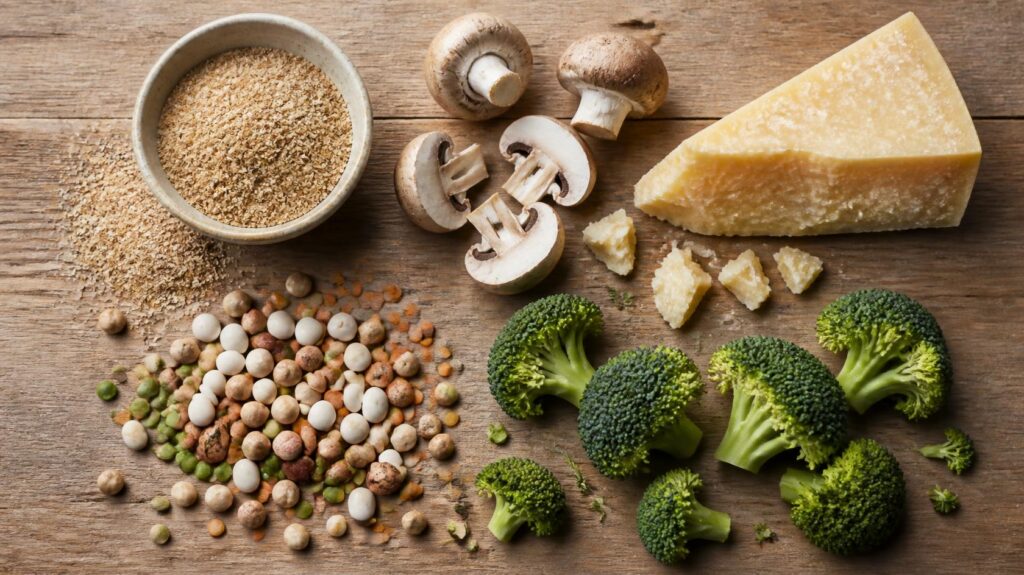
Spermidine is a polyamine. It occurs naturally in every cell in your body, and it also turns up in a lot of ordinary food. Wheat germ is one of the richest sources at roughly 243mg per kilogram. Soybean products like natto sit close behind, and you will also find meaningful amounts in aged cheeses, mushrooms, legumes, broccoli, cauliflower, green peppers and chicken liver.
Two things make it interesting from a healthy ageing point of view.
The first is that your body’s own spermidine levels tend to fall as you get older. The second is that dietary intake tends to fall too, partly because appetite and food variety often narrow with age.
So you have a compound your body uses constantly, which declines on two fronts at once. That combination is what put it on the research radar in the first place.
Why researchers are interested: autophagy
The main reason spermidine gets attention is autophagy.
Autophagy is your cells’ recycling system. It is the process by which a cell identifies old, damaged or misfolded components, breaks them down, and reuses the raw material. It is a housekeeping function, and like most housekeeping, you only notice it when it stops happening properly.
Autophagy slows with age. A good deal of current longevity research is focused on whether it can be restored, and spermidine is one of the more consistent autophagy inducers identified so far.
The foundational work here is Eisenberg et al. (2009), published in Nature Cell Biology, which showed that spermidine induced autophagy and extended lifespan in yeast, flies, worms and cultured human immune cells. A follow-up paper in Nature Medicine in 2016 reported cardioprotective effects and lifespan extension in mice.
That is a strong mechanistic story. It is also animal and cell work and mice are not people.
The human observational evidence
The most substantial human data so far is observational rather than interventional.
The Bruneck Study (Kiechl et al., 2018, American Journal of Clinical Nutrition) followed 829 people in northern Italy aged 45 to 84, assessing their diets repeatedly over roughly 20 years. The researchers looked at 146 different nutrients. Of all of them, spermidine intake showed the strongest inverse relationship with death from any cause.
People in the top third of spermidine intake had a mortality risk comparable to being about 5.7 years younger than people in the bottom third. The finding held up in subgroups, survived tests for unmeasured confounding, and was independently replicated in a separate Austrian cohort (the SAPHIR study).
That is a genuinely striking result, and it is the single strongest piece of human evidence supporting spermidine.
It is also observational, which means it can show association but not causation. People eating a lot of wheat germ, legumes, mushrooms and vegetables are probably doing other sensible things too. The researchers adjusted for what they could, but no adjustment is perfect.
The human trials
There have been three randomised controlled trials of spermidine supplementation and cognition in older adults. Here they are in order.
Wirth et al., 2018 (Cortex). A three-month Phase IIa pilot in 30 cognitively intact older adults, aged 60 to 80, with subjective cognitive decline. Participants took 1.2mg per day of spermidine from a wheat germ extract. Memory performance improved moderately in the spermidine group relative to placebo, with a reasonably large effect size, though in a trial of 30 people the confidence interval was wide and just crossed zero. The authors described it as promising and called for larger trials.
Pekar et al., 2021 (Wiener klinische Wochenschrift). Eighty-five nursing home residents in Austria, aged 60 to 96, over three months. One group ate a daily bread roll made with wheat germ providing 3.3mg of spermidine per day; the comparison group ate a roll made with wheat bran providing 1.9mg. Cognitive scores improved in the higher-dose group. Note this compared a higher dose against a lower dose, not against a true placebo, and participants were recruited via nursing home directors, which introduces some selection risk.
Schwarz et al., 2022 (JAMA Network Open). The SmartAge trial found no significant difference in memory performance or in any of the secondary biomarkers. However he authors themselves noted the dose problem as SmartAge used only 0.9mg of spermidine per day that this raised participants’ total daily spermidine supply by roughly 10 per cent. Average dietary intake in developed countries has been estimated at around 10mg per day, so a 0.9mg supplement is a small nudge on top of what people were already eating.
It did not test whether a larger increase would do something different. The trial that showed the clearest positive signal, Pekar, used 3.3mg, more than three times the SmartAge dose.
That does not necessarily explain the null result. But “the dose was low” is a an unresolved question in this literature, and it is one reason we did not think the SmartAge result closed the book.
Why we chose wheat germ over synthetic
There are two kinds of spermidine on the market, and the distinction gets glossed over a lot.
Wheat germ extract is what every human clinical trial listed above actually used. It has an established food safety profile and has been formally evaluated by the European Food Safety Authority, which set an upper safe intake of 6mg per day for food-derived spermidine.
Synthetic spermidine trihydrochloride is cheaper to produce and easier to dose to a high number on a label. It has not been assessed to the same standard for human use, and it is not the form the research was done on.
We went with wheat germ. It costs more and it brings an allergen with it, which we will come to. But if we are going to point you at the research, the product needs to be the same thing the research was testing. Anything else is borrowing credibility that has not been earned.
Our dose, and why
Our capsules provide 2mg of spermidine from wheat germ extract, one capsule per day.
That sits above above the 0.9mg used in the null trial, above the 1.2mg used in the Wirth trial, below the 3.3mg used in the Pekar trial, and comfortably under EFSA’s 6mg per day upper safe intake for food-derived spermidine. Spermidine 2mg, 60 capsules
It is inside the range the human research has explored, at the upper-middle end rather than the bottom.
Who this is not for
This product contains wheat and gluten. It is not suitable for anyone with coeliac disease or a wheat allergy. There is no way around this; wheat germ extract is the reason we chose this form, and it is also the reason some people cannot take it.
If you have an existing medical condition or take prescription medication, please talk to your GP or a registered nutritionist before starting. We are not clinicians, and this is not a substitute for that conversation.
What this means for you
Pulling it together:
- The mechanism is well-established and the animal evidence is consistent.
- The strongest human evidence is observational, and it is striking, but it does not establish cause and effect.
- Of the three human trials, two were positive and one was negative at a low dose that raised total intake by about 10 per cent.
If you are interested in a compound with a strong mechanistic rationale, a good safety profile, and some real human signal that is still being worked out, it is a reasonable addition to a healthy ageing routine.
Most of the research looked at effects over three months or longer, so give it at least that long before forming a view.
That is where we have landed although you may weigh it differently. Have a read of the studies below and decide for yourself.
View our wheat germ spermidine
References
- Eisenberg T, et al. Induction of autophagy by spermidine promotes longevity. Nature Cell Biology. 2009;11(11):1305-1314.
- Eisenberg T, et al. Cardioprotection and lifespan extension by the natural polyamine spermidine. Nature Medicine. 2016;22(12):1428-1438.
- Kiechl S, et al. Higher spermidine intake is linked to lower mortality: a prospective population-based study. American Journal of Clinical Nutrition. 2018;108(2):371-380.
- Wirth M, et al. The effect of spermidine on memory performance in older adults at risk for dementia: a randomized controlled trial. Cortex. 2018;109:181-188.
- Pekar T, et al. The positive effect of spermidine in older adults suffering from dementia: first results of a 3-month trial. Wiener klinische Wochenschrift. 2021;133(9-10):484-491.
- Schwarz C, et al. Effects of Spermidine Supplementation on Cognition and Biomarkers in Older Adults With Subjective Cognitive Decline: A Randomized Clinical Trial. JAMA Network Open. 2022;5(5):e2213875.
Stephen
MyVitality