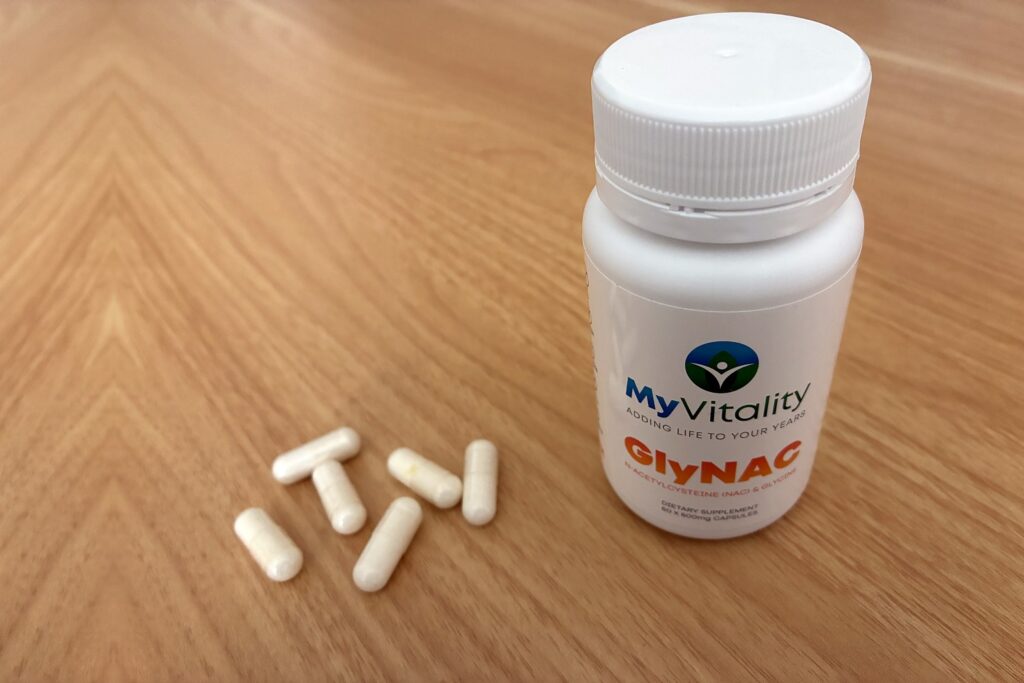
Every so often a customer tells us they started taking GlyNAC because their GP or a specialist suggested it. It has happened often enough now that we started paying attention, and it made us curious. Doctors are, quite rightly, cautious about supplements. So what is it about this one?
We are not doctors and we cannot speak for anyone else’s, so what follows is our best understanding rather than an explanation from the profession. But there are two things about GlyNAC that we think make it different.
The ingredients are familiar
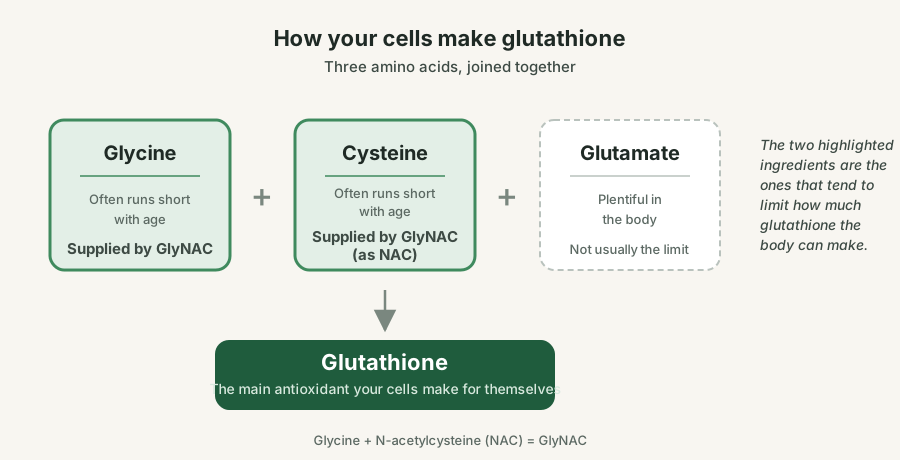
GlyNAC is a combination of two well-known compounds: glycine and N-acetylcysteine, usually shortened to NAC.
Glycine is an amino acid. Your body makes some of it, and you get more from food, particularly from collagen-rich foods like bone broth, slow-cooked meat and gelatine. NAC is a form of the amino acid cysteine. It has been used in hospitals for decades, mainly to thin mucus in lung conditions and as the standard treatment for paracetamol overdose.
Both are precursors to glutathione, the main antioxidant your cells make for themselves. Glutathione is built from three amino acids: glycine, cysteine and glutamate. Glutamate is plentiful. Glycine and cysteine are the ones that tend to run short, and research suggests glutathione levels fall with age in many people.
So a doctor looking at GlyNAC is not looking at a novel compound with an unfamiliar mechanism. They are looking at two ingredients they already know, aimed at a process they already understand. That is a very different starting point from NMN, spermidine or CA-AKG, where the science is promising but newer.
The human research is more direct than most
The second reason is the research itself, most of it from one lab at Baylor College of Medicine in Houston, led by Dr Rajagopal Sekhar.
The 2021 pilot study. Eight older adults (average age around 70) took GlyNAC for 24 weeks, then stopped for 12 weeks. Compared with their starting point, the group showed improvements in glutathione levels, oxidative stress, mitochondrial function, inflammation, insulin resistance, muscle strength, walking speed and some cognitive measures. Then, after 12 weeks without it, most of those measures drifted back toward where they started. This was a small, open-label study with no placebo group, so it was a signal rather than proof.
Published in Clinical and Translational Medicine, 2021: https://pubmed.ncbi.nlm.nih.gov/33783984/
The 2023 randomised controlled trial. Twenty-four older adults were randomly assigned to take either GlyNAC or a placebo (alanine, an amino acid with no expected effect) for 16 weeks. The GlyNAC group showed improvements in glutathione levels, oxidative stress, mitochondrial function, inflammation, insulin resistance, endothelial function and gait speed. The placebo group did not. The researchers also looked at a number of the recognised hallmarks of ageing and reported improvements in several of them.
Published in the Journals of Gerontology Series A, 2023: https://pubmed.ncbi.nlm.nih.gov/35975308/
Most of what we sell rests on strong mechanistic reasoning and animal studies, with human trials still catching up. GlyNAC arrived with a placebo-controlled human trial already published. It is one of the reasons we added it to the range.
What the studies do not tell you
A few things to keep in mind, because they are easy to skip past.
It was a small trial. Twenty-four people is enough to show an effect, not enough to be confident about how large or how consistent it is across a wider population. The authors themselves say larger trials are needed.
It is mostly one research group. Nearly all of the human GlyNAC research comes from the Baylor lab. Independent replication has not yet caught up. It is also worth noting that Baylor holds a patent on the GlyNAC combination and has licensed it to Nestlé Health Science. That does not make the research wrong, but it is context.
The trial participants were healthier than average. The 2023 study deliberately excluded older adults with multiple health conditions, so the results reflect ageing on its own rather than ageing plus illness. Interestingly, the participants did not report feeling any different on quality of life questionnaires, even though their blood and muscle measurements improved. The authors suggest 16 weeks may not be long enough for biological changes to translate into how you feel.
The doses were high. Participants took roughly 100mg of glycine and 100mg of NAC per kilogram of bodyweight per day. For a 75kg person that is around 7.5g of each, spread across the day. Our GlyNAC provides 600mg of each per capsule, or 1200mg of each at the recommended two capsules a day. That is a typical supplement serving, and below the trial amounts. Whether lower amounts produce a proportionally smaller effect, a similar effect, or no meaningful effect has not been tested. Anyone wanting to take more should talk to their doctor or a nutritionist first, particularly if they take other medications.
The benefits appear to depend on continuing. In both studies, measures drifted back after supplementation stopped. GlyNAC looks like something you keep taking rather than a course you complete.
Our take
We think the reason GlyNAC comes up in doctors’ conversations is simple: the ingredients are familiar, the mechanism is understood, and there is a placebo-controlled human trial to point to.
It is not a miracle and the research is still early. But of everything in our range, GlyNAC is one of the products where the gap between the theory and the human evidence is narrow, which is why it has become our second most popular product after NMN.
If you have questions, or if your own doctor has said something about GlyNAC that we have not covered here, we would like to hear it. Reply to any of our emails or call us on [phone number]. We are always learning.
Stephen
This article is for general information and is not medical advice. GlyNAC may support healthy glutathione levels as part of a balanced diet and lifestyle. Talk to your doctor before starting any supplement, especially if you have a medical condition or take medication.