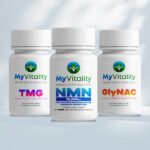

The science of healthy ageing
The way we age is shaped by biology we’re only beginning to understand, and the research is moving quickly. This is a plain-English look at the science behind our range: the decline in NAD⁺ that has made NMN so widely studied, and the other processes that matter as we age, from cellular cleanup to antioxidant defence, and the compounds researchers are exploring for each.
Why NAD⁺ matters
NAD⁺ (nicotinamide adenine dinucleotide) is a coenzyme found in every cell in your body. It plays a central role in turning the food you eat into usable cellular energy, and in the repair processes that keep cells working as they should.
Research has shown that NAD⁺ levels fall as we get older, by some estimates roughly halving between young adulthood and middle age. That decline has become one of the most active areas of longevity science, and it’s the reason NAD⁺ precursors like NMN and NR have drawn so much attention.

Held to a higher standard
Why dose and purity matter
Human NMN studies have used daily doses ranging from 250mg up to more than 1,000mg. A 2022 dose-comparison trial found that 600mg per day produced the strongest improvements in physical performance, with higher doses adding little on top. That is why our standard serving is two 300mg capsules, 600mg daily, though the capsule format makes it easy to adjust. Some of our customers take less, and some choose higher intakes in line with published protocols.
Dose is only half the story. Purity and absorption determine how much of a compound actually reaches your cells, which is why every MyVitality product is formulated to a research-informed dose and independently third-party tested, with our NMN verified at 99%+ purity, so you know exactly what’s in each capsule.

Why two 300mg capsules?
Research-informed, not marketing-driven.
A 2022 human trial comparing 300mg, 600mg and 900mg daily found 600mg gave the best balance of benefit and value, so that’s our standard serving. Doses above 600mg have been well tolerated in studies, and our capsule format lets you adjust to suit your own approach.
Our NMN is 99%+ pure and independently verified.

Healthy ageing is more than one molecule
NAD⁺ decline is one of the best-studied changes that comes with age, but it’s not the only one. Ageing research points to several processes worth paying attention to, and our range is built around them.
Cellular cleanup
As we age, the body’s process for clearing out damaged cell components, called autophagy, slows down. Spermidine is one of the most studied compounds for supporting it, with research linking dietary spermidine to healthy ageing outcomes.
Antioxidant defence
Glutathione, the body’s main internal antioxidant, declines with age. GlyNAC provides glycine and NAC, the two building blocks the body uses to make it, and early human trials in older adults have shown encouraging results. Ergothioneine, a rare amino acid found in mushrooms, is being studied for its role in protecting cells from oxidative stress, and we pair it with PQQ, which is being researched for mitochondrial support.
Energy and metabolism
Alpha-ketoglutarate is a molecule at the centre of how cells produce energy, and its levels fall with age. CA-AKG is the form used in ageing research, including early human studies. TMG supports the body’s methylation cycle, which is one reason many people researching NAD⁺ precursors choose to take it alongside NMN.
Sirtuins and cellular resilience
Trans-resveratrol is one of the most researched compounds in longevity science, studied for how it interacts with sirtuins, the same family of proteins that depend on NAD⁺.

Joints, skin and connective tissue
Hyaluronic acid is what keeps joints cushioned and skin hydrated, and the body makes less of it as we age. Oral supplementation has human research behind it for both joint comfort and skin hydration.
Every compound in our range earns its place the same way: enough credible research to be worth taking seriously, formulated at research-informed doses, and third-party tested. Where the evidence is still emerging, we say so.
Common questions
NMN (nicotinamide mononucleotide) is a direct precursor to NAD⁺, a molecule your cells rely on for energy production and repair. Supplementing with NMN is one of the ways researchers are exploring to help support the body’s NAD⁺ levels as we age.
Human NMN studies have used daily doses from 250mg up to more than 1,000mg. The most useful comparison to date, a 2022 trial testing 300mg, 600mg and 900mg daily, found that all three raised NAD⁺ levels, with 600mg giving the strongest improvement in physical performance and little extra benefit above that.
Our standard serving of two 300mg capsules (600mg daily) reflects that finding. Some customers take one capsule, others choose higher intakes based on protocols they follow, and the capsule format makes it easy to adjust. If you’re new to NMN, starting at one capsule daily for the first few weeks is a sensible way to see how you get on.
Every batch of our NMN is independently tested by a third-party laboratory to verify 99%+ purity, and the same applies across our range. We don’t just take our suppliers’ word for it, and we don’t ask you to take ours.
All our products are formulated and encapsulated here in New Zealand, so we can stand behind exactly what goes into each capsule. If you’d like to see the test results for the product you’ve purchased, get in touch and we’ll send them through.
No. Our products are dietary supplements, not medicines, and they’re not intended to diagnose, treat, cure or prevent any disease.
The research into compounds like NMN is genuinely promising, but much of it is still emerging, and we’d rather tell you that plainly than dress supplements up as something they’re not. If you have a health condition, take prescription medication, or are pregnant or breastfeeding, talk to your GP or pharmacist before adding any supplement to your routine.
Join 1,200+ Kiwis on their longevity journey
Get 20% off your first order, plus monthly research updates, new product launches, and subscriber-only discounts.