In short: in the first direct human comparison (Nature Metabolism, January 2026), NMN and NR raised blood NAD+ to a similar degree, roughly doubling levels after 14 days of daily use. Plain vitamin B3 did not produce a lasting increase. The study measured NAD+ levels, not health outcomes.
Since we started this business in 2020, one question has come up more than almost any other: NMN vs NR, which should I take? Both are precursors to NAD+, the molecule our cells rely on for energy production and hundreds of other processes, and one whose levels are being studied in relation to ageing. Until recently, though, no one had ever compared them directly in people.
In January 2026, that changed. A research team published the first head-to-head human trial of the three main NAD+ precursors in Nature Metabolism.
What the researchers did
The study enrolled 65 healthy adults and randomly assigned them to one of four groups: 1,000mg of NMN daily, 1,000mg of NR daily, 500mg of nicotinamide (plain vitamin B3) daily, or a placebo. Doses were chosen to be roughly equivalent molecule for molecule. Participants took their assigned capsule every day for 14 days, and the researchers measured NAD+ and related compounds in their blood at the start, during, and at the end.
What they found
After two weeks, both the NMN and NR groups showed roughly a doubling of NAD+ levels in whole blood compared with placebo. The increases in the two groups were statistically indistinguishable from each other. In other words, on the measure that matters most for this category, NMN and NR performed the same.
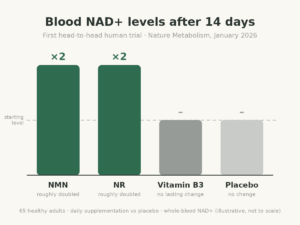
Nicotinamide told a different story. It produced a rapid, short-lived rise in blood levels within the first hour or so of each dose, but after 14 days it had not raised baseline NAD+ at all. Fast in, fast out, no lasting change.
All three supplements were well tolerated, with only a handful of minor adverse events across the whole study, spread evenly between groups including placebo.
The gut connection
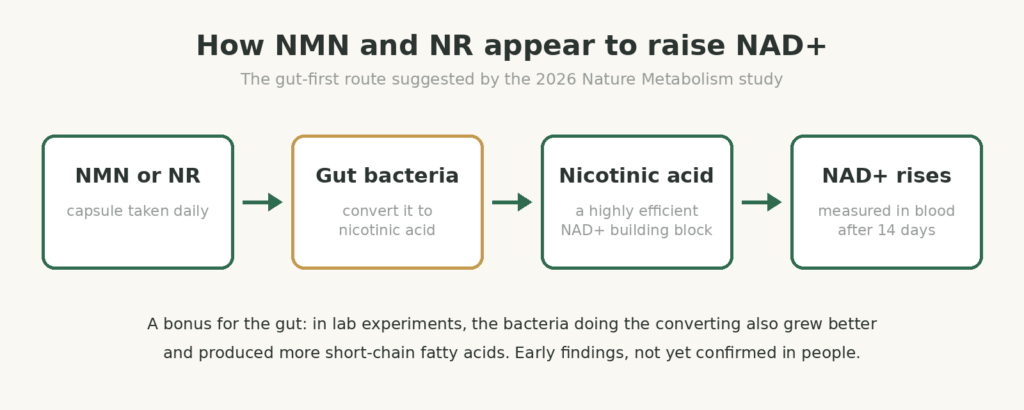
One interesting part of the study wasn’t the main result. The researchers also ran laboratory experiments exposing human gut bacteria to NMN and NR, and found that the bacteria convert both into nicotinic acid, a compound that separate blood experiments showed to be a remarkably efficient NAD+ precursor.
This suggests a somewhat surprising model: NMN and NR may not be absorbed directly into the bloodstream in meaningful amounts. Instead, they appear to linger in the gut, where our microbes transform them into the form that actually raises NAD+. And the microbes seem to do well out of the arrangement. In the lab experiments, both compounds boosted bacterial growth and increased production of short-chain fatty acids, the same beneficial compounds produced when we eat fibre.
Insert the pathway diagram here (gut-pathway-diagram.png), if not used as the hero image:
A note of caution here: the gut findings came from laboratory fermentation experiments using donated microbiome samples, not from measuring gut changes in the trial participants themselves. So this part is best read as an early and promising lead rather than a proven benefit.
The limitations
We always want to try to understand the full picture, so here is what this study doesn’t tell us.
It was open-label, meaning participants knew which supplement they were taking. Because the main outcome was a blood measurement rather than how anyone felt, this matters less than it would in, say, a sleep study, but it’s still a design compromise.
The participants were healthy adults with an average age of about 35. Most of our customers are older than that. Earlier studies in older adults have shown similar NAD+ increases from both compounds, so there’s reason to expect the finding carries over, but this particular trial can’t confirm it.
The study measured NAD+ levels, not health outcomes. Raising NAD+ is the mechanism being studied, not a demonstrated benefit in itself. Whether restoring NAD+ translates into meaningful differences for healthy ageing is exactly what larger, longer trials are working to establish.
Finally, the study was conducted by Nestlé Research, and the NR product used was Tru Niagen, a brand with commercial links to Nestlé. Funding sources are always worth knowing. It’s worth noting that if the funding influenced anything, it didn’t show in the results: NMN, which the funder has no stake in, performed just as well as NR.
What this means for you
If you’ve been weighing up NMN versus NR, this study suggests that both raise NAD+ effectively and to a similar degree, at least over two weeks in healthy adults. The choice may come down to practical factors like dose format and price rather than a meaningful difference in effect.
If you’re taking plain vitamin B3 in the hope of supporting NAD+ levels long term, this study suggests it may not achieve that on its own, despite being cheaper.
And if the gut findings hold up in future human trials, NMN and NR may turn out to offer something beyond NAD+ support. We’ll be watching that research closely and will report back as it develops.
We stock both NMN and NR, formulated and encapsulated in New Zealand with third-party testing. If you have questions about either, reply to any of our emails or get in touch. We’re not scientists, and some of you know more about this field than we do, but we do our best to read the research carefully and share it straight.
The study: Christen, S. et al. The differential impact of three different NAD+ boosters on circulatory NAD and microbial metabolism in humans. Nature Metabolism 8, 62–73 (2026). Read it here (open access)
This article is for general information only and is not medical advice. Dietary supplements are not intended to diagnose, treat, cure, or prevent any disease. Talk to your GP or a qualified health professional before starting any supplement, particularly if you take medication or have a health condition.