Nutrients and the ageing brain: what the multivitamin and choline studies show


A large multivitamin trial and two choline studies point the same way: everyday amounts of ordinary nutrients may support memory as we age. What they found, and their limits.
For years the standard line on multivitamins was that they do little more than make expensive urine. Some of the research since then, particularly on multivitamins and memory, paints a more interesting picture.
This article looks at the largest multivitamin trial so far and two studies on choline, a nutrient that gets less attention.
We paired hyaluronic acid with a low-dose multivitamin because the two seemed a complementary fit: one for skin and joints, the other a top-up of nutrients some diets miss.
Multivitamins and memory: the COSMOS trial
COSMOS gave 21,442 Americans (men 60 and over, women 65 and over) either a standard daily multivitamin or a placebo for a median of 3.6 years.
Three sub-studies tested thinking and memory by phone, online and in person. Pooled, they covered 5,203 people over two to three years. The multivitamin group did better on overall cognition and on episodic memory, the kind used to recall events and lists. The authors describe the difference as equivalent to about two years less cognitive ageing [1].
Some context for that result:
- The trial did not measure dementia diagnoses.
- All three sub-studies drew on the same parent trial.
- The multivitamin was Centrum Silver, which has more than twenty vitamins and minerals. Whether other formulas do the same is unknown.
- The main trial found no change in cancer or heart disease.[2].
Choline
Choline is an essential nutrient. The body uses it to build cell membranes and to make acetylcholine, one of the brain’s chemical messengers. Eggs, meat and dairy are the main sources. The adequate intake in New Zealand is 550mg a day for men and 425mg for women [3].
A Finnish study followed 2,497 men aged 42 to 60 for an average of 21.9 years [4]. Men in the highest quarter for phosphatidylcholine, the main form of choline in food, had a 28% lower risk of dementia than men in the lowest quarter. Total choline intake showed no clear link with dementia. In a subset of 482 men, higher intakes of both went with better scores on verbal fluency and memory tests four years on.
This was an observational study. It recorded what the men ate over four days at the start and cannot show that choline caused the difference. It also included only men.
A smaller trial tested a choline compound directly [5]. One hundred adults aged 50 to 85 with age-related memory complaints took 500mg of citicoline or a placebo daily for 12 weeks. The citicoline group improved more on episodic memory and on a combined memory score. The trial’s main measure, a spatial memory test, did not differ significantly between the groups. The study was funded by the company that makes the citicoline used.
Everyday amounts
The multivitamin in COSMOS was a standard one, and the Finnish men got their choline from food. None of this research points towards large doses.
With some vitamins, large doses have caused problems. Australia’s regulator is moving products with more than 50mg a day of vitamin B6 behind the pharmacy counter from June 2027, after reports of nerve damage [6]. A US expert panel advises against vitamin E and beta-carotene supplements for preventing heart disease or cancer, on the strength of trials where high doses did harm [7].
What is in our capsule
Our Hyaluronic Acid with Micro Vitamin pairs 225mg of hyaluronic acid with twelve micronutrients in a daily serving of two capsules. The table sets that serving against the New Zealand and Australian recommended or adequate intakes for adults aged 51 to 70 [3].
| Nutrient | In a daily serving | Recommended daily intake (men / women) | Roughly |
| Thiamin (B1) | 1mg | 1.2mg / 1.1mg | 0.8 to 0.9 times |
| Riboflavin (B2) | 1mg | 1.3mg / 1.1mg | 0.8 to 0.9 times |
| Niacin (B3) | 65mg | 16mg / 14mg | 4 to 5 times |
| Pantothenic acid (B5) | 4mg | 6mg / 4mg | 0.7 to 1 times |
| Vitamin B12 | 2mcg | 2.4mcg | 0.8 times |
| Vitamin C | 40mg | 45mg | 0.9 times |
| Vitamin D3 | 20mcg | 10mcg (15mcg over 70) | 1.3 to 2 times |
| Vitamin K (as K2 MK-7) | 100mcg | 70mcg / 60mcg | 1.4 to 1.7 times |
| Iodine | 77mcg | 150mcg | about half |
| Zinc | 6mg | 14mg / 8mg | 0.4 to 0.75 times |
| Choline | 190mg | 550mg / 425mg | 0.35 to 0.45 times |
| Potassium | 105mg | 3,800mg / 2,800mg | a small top-up |
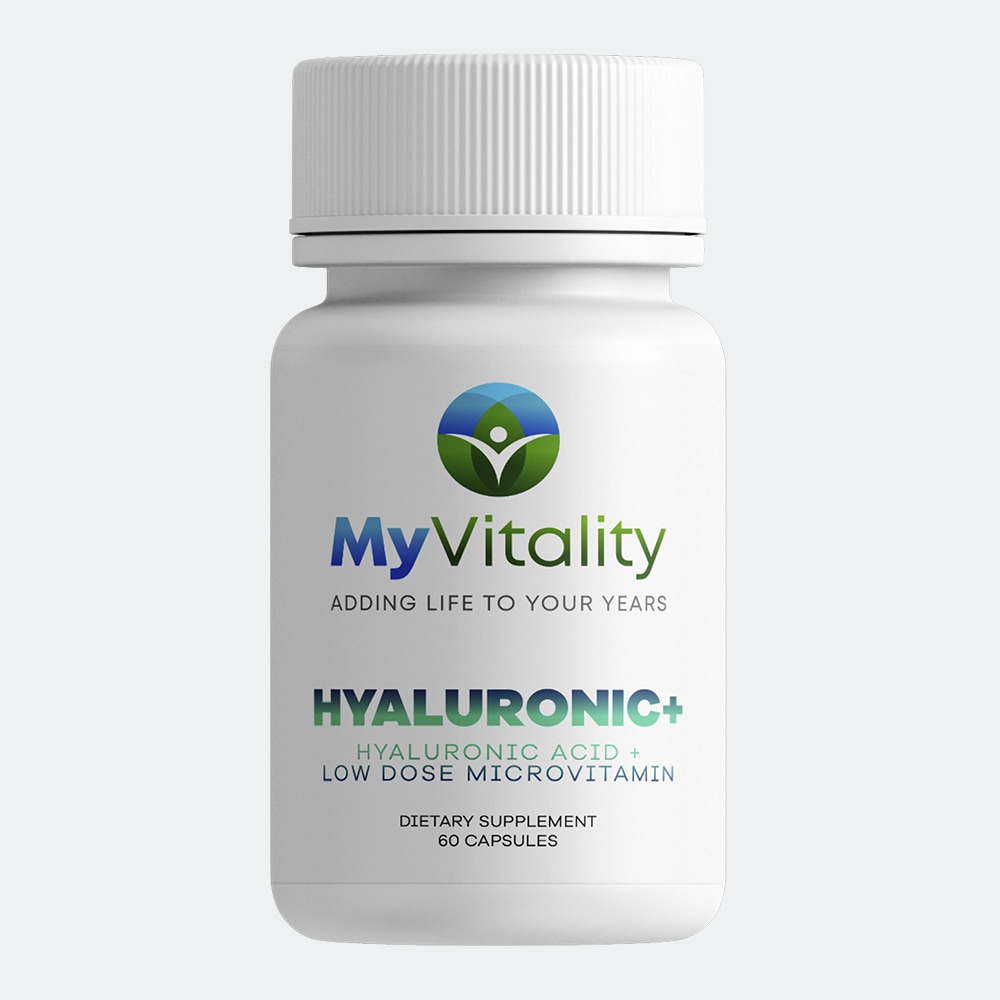 Most of the vitamins sit at or just under the recommended intake, which leaves room for what food provides. The 190mg of choline is a little more than a large egg supplies. There is no vitamin B6, vitamin A, vitamin E or beta-carotene in the formula.
Niacin is the one nutrient set above the recommended intake. It is in the nicotinamide form, which does not cause flushing and has an upper level of 900mg a day.
Two things to be clear about. The choline in our capsule is choline bitartrate, a different form from the phosphatidylcholine and citicoline in the studies above. And our formula is not the multivitamin COSMOS tested. We read this research as support for the general idea, and it says nothing direct about our capsule.
Anyone taking warfarin should talk to their doctor before taking a supplement containing vitamin K.
What this means for you
- Food comes first. Two eggs provide roughly 300mg of choline, and a varied diet covers most vitamins.
- A low-dose multivitamin is a top-up for the days and the nutrients that food misses.
- The research on nutrients and memory is still building. The results so far are modest and mostly point the same way.
- If you take prescription medicines or have a health condition, run any new supplement past your GP or pharmacist.
Stephen
References
- Vyas et al., COSMOS-Clinic and meta-analysis of three cognitive studies within COSMOS, American Journal of Clinical Nutrition 2024
- World Health Organization, updated guidelines on reducing the risk of cognitive decline and dementia, 15 July 2026
- Nutrient Reference Values for Australia and New Zealand, NHMRC and NZ Ministry of Health
- Ylilauri et al., dietary choline intake, incident dementia and cognitive performance, American Journal of Clinical Nutrition 2019
- Nakazaki et al., citicoline and memory function in healthy older adults, Journal of Nutrition 2021
- Therapeutic Goods Administration, medicines containing vitamin B6
- US Preventive Services Task Force, vitamin and mineral supplements recommendation statement, JAMA 2022